
Healthy eating can sound complicated. One day you hear that you should eat more protein. The next day, someone says you should avoid carbohydrates. Then there are different diets, superfoods, supplements, fasting plans, and countless opinions about what you should or shouldn’t eat. It can be difficult to know what actually matters.
The truth is that healthy eating doesn’t have to be complicated. You don’t need to follow a strict diet or completely change the foods you enjoy. A healthy diet is mostly about the overall pattern of what you eat. That means eating a good variety of foods, getting plenty of vegetables and fruits, choosing nutritious sources of protein and carbohydrates, and not relying too heavily on foods that are high in added sugar, sodium, or unhealthy fats.
You also don’t have to get everything right at every meal. What matters most is what your eating habits look like over days, weeks, and months.
What Does Healthy Eating Actually Mean?
At its simplest, healthy eating means giving your body a good mix of the nutrients it needs. Your body needs protein, carbohydrates, fats, vitamins, minerals, fiber, and water. These nutrients come from many different foods, which is why variety matters so much.
For example, vegetables can provide fiber, vitamins, minerals, and other plant compounds. Whole grains can provide carbohydrates and fiber. Beans and lentils provide protein and fiber. Eggs, fish, dairy foods, nuts, and seeds can provide protein along with other important nutrients.
No single food does everything. That’s why a healthy diet isn’t about finding one “perfect” food. It’s about putting different foods together in a way that gives your body what it needs.
The World Health Organization describes a healthy diet around four basic ideas: (i)adequacy, (ii)balance, (iii)moderation, and (iv) diversity. What that looks like in practice can vary from one person to another. (WHO) And that’s worth remembering.
A healthy diet for a college student may not look exactly the same as a healthy diet for an older adult, an athlete, or someone with a medical condition.
Why Is Healthy Eating Important?
Food isn’t just about calories or satisfying hunger. It’s the fuel and raw material your body uses every day. The nutrients in food help support everything from normal growth and tissue repair to digestion, immune function, and energy production. Eating a varied diet can also help you get enough of the nutrients that are difficult to obtain when your food choices are very limited.
Over the long term, healthy dietary patterns are associated with a lower risk of several chronic diseases, including cardiovascular disease and type 2 diabetes. Diet is only one part of the picture, though. Genetics, physical activity, sleep, stress, environment, and access to healthcare all matter too. (WHO)
Healthy eating and digestion
One of the easiest ways to improve your diet is to pay attention to fiber.
Fiber is found naturally in foods such as vegetables, fruits, beans, lentils, whole grains, nuts, and seeds. It helps support normal digestive function and can be an important part of a healthy diet.
If you’re currently eating very little fiber, don’t suddenly double your intake overnight. Increase it gradually and make sure you’re drinking enough fluids.
Healthy eating and energy
Your body needs energy to work, exercise, concentrate, move around, and carry out basic functions.
A diet that contains a mixture of carbohydrates, protein, and fats can provide that energy while also supplying important nutrients.
If you regularly feel tired, though, don’t automatically assume that your diet is the cause. Persistent or unexplained fatigue can have many causes and may be worth discussing with a healthcare professional.
What Foods Should You Eat?
There isn’t a single shopping list that everyone needs to follow. Instead, think about building your diet around a variety of foods.
Vegetables
Vegetables deserve a regular place on your plate. Leafy greens, carrots, broccoli, tomatoes, peppers, cabbage, cauliflower, peas, green beans, and many other vegetables can all contribute nutrients and fiber to your diet.
Try not to get stuck eating the same two or three vegetables all the time. Different vegetables offer different combinations of nutrients, so variety is useful. And don’t worry if you can’t buy fresh vegetables every day.
Frozen vegetables can be a perfectly practical option, and canned vegetables can also fit into a healthy diet. If you’re buying canned vegetables, checking the sodium content can help you choose a lower-sodium option.
Related article: Are Frozen Vegetables Healthy?
Fruits
Fruit is another simple way to add nutrients and fiber to your diet. Apples, oranges, bananas, berries, mangoes, pears, melons, grapes, and many other fruits can fit into a healthy eating pattern.
You don’t need to avoid fruit because it contains sugar. The sugar in whole fruit naturally comes packaged with water, fiber, and other nutrients.
For most people, whole fruit is a better everyday choice than fruit juice because it contains more of the original fiber and tends to be more filling.
Whole Grains
Not all carbohydrates are the same. Whole grains such as oats, brown rice, barley, quinoa, bulgur, and whole-wheat bread can provide fiber and other nutrients.
You don’t need to completely stop eating white rice, white bread, or other refined grains. If they’re part of your normal diet, a realistic approach is to replace some of them with whole-grain choices.
For example, you might have oatmeal instead of a highly sweetened breakfast cereal, or brown rice a few times a week instead of always choosing white rice. Small changes are often easier to maintain than dramatic ones.
Protein-Rich Foods
Protein is needed to build and maintain tissues, among other important functions. There are plenty of ways to get it. Beans, lentils, chickpeas, eggs, fish, chicken, lean meats, yogurt, milk, tofu, nuts, and seeds can all contribute protein to your diet.
You don’t have to eat meat at every meal to get enough protein. Plant foods such as beans and lentils can be particularly useful because they provide both protein and fiber.
Healthy Fats
Fat has sometimes been given an unnecessarily bad reputation. Your body actually needs fat. The important question is which types you eat and how much.
Foods such as nuts, seeds, avocado, fish, and plant oils provide predominantly unsaturated fats.
Rather than trying to remove fat from your diet, it generally makes more sense to choose healthier sources more often and limit foods high in saturated and trans fats. (WHhttps://www.who.int/news-room/fact-sheets/detail/healthy-dietO)
What Should a Healthy Plate Look Like?
You don’t need to weigh every ingredient or calculate every nutrient to make a balanced meal. A simple plate can give you a useful starting point.
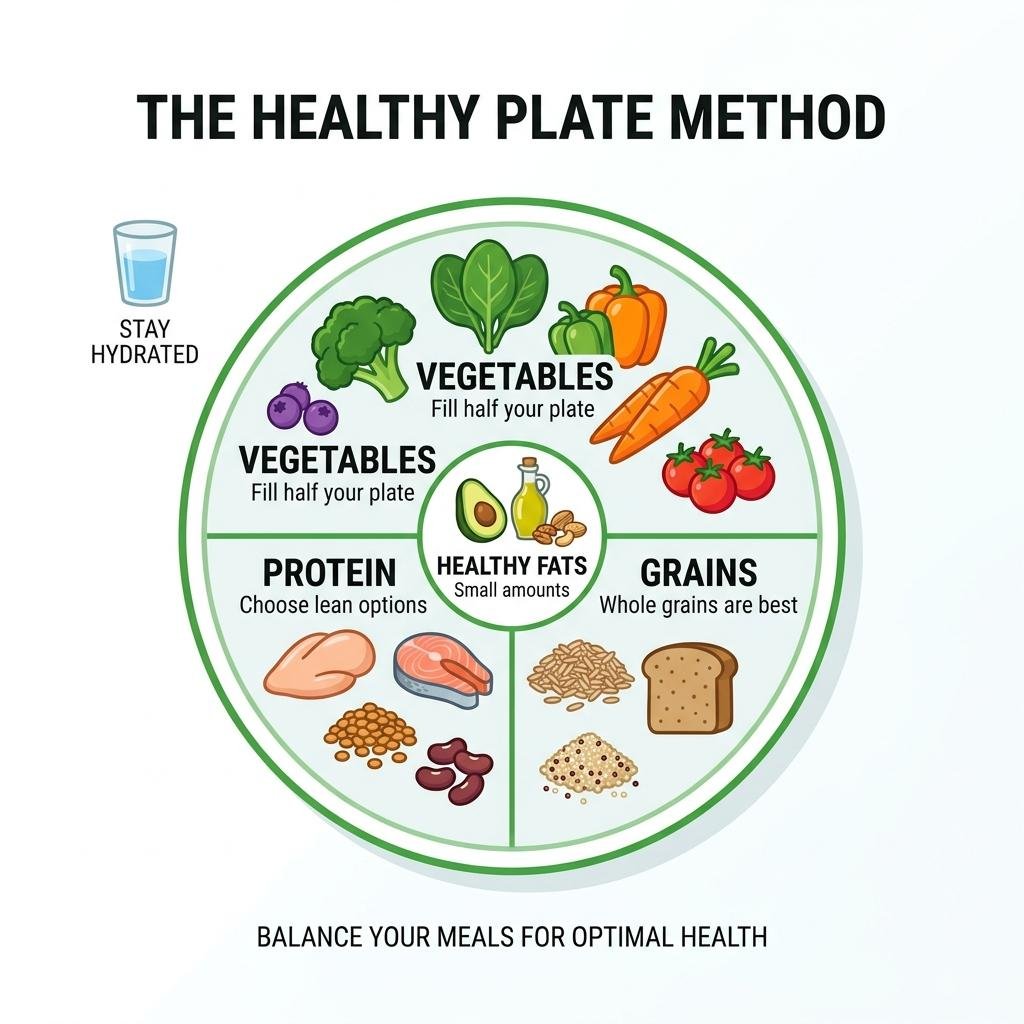
Harvard’s Healthy Eating Plate suggests filling about half your plate with vegetables and fruit, with the other half divided between whole grains and healthy protein. It also recommends using healthy plant oils in moderation and choosing water or other appropriate beverages. (Harvard T.H. Chan School of Public Health)
Think of it as a visual reminder rather than a strict rule. For example, dinner could be
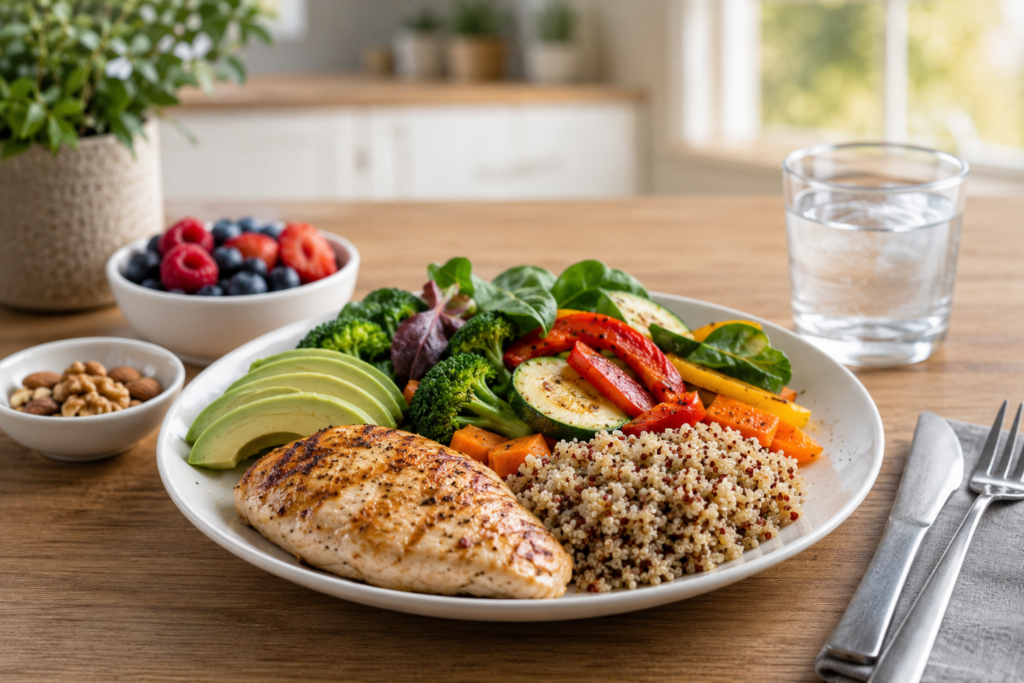
- Grilled chicken, brown rice, and a large serving of mixed vegetables.
- Or it could be lentils with vegetables and whole-grain roti.
- Or fish with potatoes and a salad.
The foods don’t have to look like something from a nutrition textbook. The basic idea is simply to include a good mixture of foods.
Healthy Eating Habits That Are Actually Realistic
Knowing what to eat is one thing. Doing it consistently is another. This is where healthy eating habits become important.
Start adding better foods instead of banning everything
If you tell yourself that you can never eat sweets, fast food, bread, rice, or your favorite snack again, you’re probably making the change harder than it needs to be.
- Try adding nutritious foods first.
- Put some fruit alongside breakfast.
- Add vegetables to lunch.
- Have beans or lentils more often.
- Keep nuts or fruit available when you’re hungry between meals.
You may find that improving what you eat naturally reduces how often you reach for less nutritious options.
Make water your everyday drink
Water is one of the easiest things to overlook. If you regularly drink soft drinks, sweetened juices, or other sugary beverages, replacing some of them with water can be a simple improvement.
You don’t need an expensive detox drink or special powder. Plain water works just fine.
Don’t underestimate breakfast
Breakfast doesn’t need to be elaborate.
- Oatmeal with fruit and nuts
- eggs with vegetables and whole-grain toast
- plain yogurt with fruit can all make simple breakfasts.
If you don’t normally eat breakfast, you don’t necessarily need to force yourself to. What matters is the quality of your overall diet.
Keep healthy food within reach
This sounds obvious, but it works. If the only snack available when you’re hungry is a packet of chips, that’s probably what you’ll eat.
- Keep fruit on the counter.
- Put yogurt in the refrigerator.
- Have nuts available.
- Keep vegetables that are easy to prepare.
Making the healthier choice convenient can make a surprisingly big difference.

How to Start Eating Healthy Without Overhauling Your Life
You don’t need to wake up Monday morning and completely change your diet. In fact, trying to change everything at once can be one of the quickest ways to give up. Instead, pick one or two things.
For example,
- start by adding vegetables to dinner.
- Once that becomes normal, work on your breakfast.
- Then look at your drinks.
- Then start replacing some refined grains with whole grains.
After a few months, those small changes can add up to a very different eating pattern.
Try this simple approach
First: Look at what you already eat.
Next: Find one thing that’s easy to improve.
Then: Make that change consistently.
After that: Move on to the next change.
There’s no prize for changing your entire diet in seven days. The goal is to build habits that still make sense six months from now.
What Foods Should You Limit?
Healthy eating isn’t about creating a giant list of forbidden foods. Some foods simply work better as occasional choices rather than everyday staples.
Foods and drinks high in added sugar
Soft drinks, sweets, desserts, and many packaged foods can contain a lot of added or free sugar. You don’t have to completely eliminate them. But if sugary drinks are a daily habit, cutting back can be a useful place to start.
WHO recommends limiting free sugar intake as part of a healthy diet. (WHO)
Foods high in sodium
Your body needs sodium, but too much can contribute to high blood pressure. A lot of sodium comes from packaged and prepared foods rather than the salt shaker sitting on your kitchen table.
Checking nutrition labels and choosing lower-sodium options when available can help.
Foods high in saturated and trans fats
Some foods naturally contain saturated fat, but diets high in saturated fat can be less healthy than patterns that emphasize unsaturated fats. Industrial trans fats are particularly undesirable, and WHO recommends avoiding them. (WHO)
Highly processed foods
This is where things can get confusing. “Processed” doesn’t automatically mean “bad.”
Frozen vegetables are processed. Milk is processed. Canned beans are processed. Bread is processed. The better question is what the food actually contains and how often you eat it.
A frozen bag of plain vegetables is very different nutritionally from a highly processed snack that’s mostly refined starch, added sugar, sodium, and fat.
Healthy Eating on a Budget
One of the biggest misconceptions about healthy eating is that it has to be expensive. It doesn’t. Some of the most useful foods in a healthy diet can be quite affordable.
Think about:
- Oats
- Beans
- Lentils
- Eggs
- Potatoes
- Bananas
- Seasonal vegetables
- Brown or other whole grains
- Frozen vegetables
Beans and lentils are particularly useful because they can provide protein and fiber without costing as much as some animal protein sources.
Buying seasonal produce, planning meals, comparing prices, and using frozen foods when appropriate can also make a healthy diet more affordable.
You don’t need to fill your shopping cart with expensive “health foods.”
What Does a Healthy Day of Eating Look Like?
There’s no single perfect menu, but here’s an example of how the principles can come together.
Breakfast
Oatmeal topped with berries and a small amount of nuts.
Lunch
Lentil or chicken salad with plenty of vegetables and whole-grain bread.
Snack
An apple with a small serving of peanut butter, or plain yogurt with fruit.
Dinner
Fish or beans, vegetables, and brown rice or another whole grain.
Drinks
Mostly water, with tea or coffee if you enjoy them.
Notice that nothing here is particularly unusual. That’s the point. Healthy eating doesn’t have to look exotic, expensive, or complicated.
7 Healthy Eating Habits to Try This Week
If you want to start today, don’t worry about doing everything. Try these instead:
1. Add one more vegetable to your day. It could be as simple as adding tomatoes or cucumber to lunch.
2. Eat a piece of whole fruit instead of drinking juice.
3. Replace one refined grain with a whole-grain option.
4. Drink water instead of one sugary drink.
5. Include a protein source with your main meals.
6. Keep a healthy snack available.
7. Plan tomorrow’s meals tonight.
If you manage even a few of these consistently, you’ve already started changing your eating habits.
Healthy Eating for Different People
There isn’t one diet that works exactly the same way for everyone.
- Children have different nutritional needs from adults. Someone who exercises heavily may need more energy than someone who is mostly sedentary. Older adults may have different nutritional priorities.
- People with conditions such as diabetes, kidney disease, food allergies, or other medical concerns may also need individualized dietary advice.
That’s why general healthy eating information shouldn’t replace advice from a doctor or registered dietitian when you have a specific medical or nutritional concern.
Related article: Diabetes: A Complete Guide to Types, Causes, Symptoms and Management
Common Healthy Eating Mistakes
Sometimes the biggest problem isn’t knowing what healthy food is. It’s approaching healthy eating in a way that’s impossible to maintain.
1. Trying to change everything at once
A completely new diet can feel exciting for a week and exhausting afterward. Give yourself time.
2. Cutting out entire food groups unnecessarily
Unless you have a specific medical or dietary reason, there’s usually no need to declare an entire food group off-limits.
3. Believing expensive foods are automatically healthier
A higher price doesn’t guarantee better nutrition.
4. Obsessing over one ingredient
A food shouldn’t necessarily be judged by one ingredient or one number on the nutrition label. Look at the bigger picture.
5. Thinking one unhealthy meal ruins your progress
It doesn’t. If you eat a burger and fries one evening, you haven’t destroyed your diet. Just return to your normal eating habits at the next meal.
Frequently Asked Questions
1. What is healthy eating?
Healthy eating means regularly choosing a variety of foods that provide the nutrients your body needs. This generally includes vegetables, fruits, whole grains, legumes, protein-rich foods, and healthy sources of fat while limiting excessive amounts of added or free sugars, sodium, saturated fats, and trans fats.
2. Why is healthy eating important?
A balanced diet helps provide the nutrients your body needs and can support overall health. Healthy dietary patterns are associated with a lower risk of several chronic diseases, although diet is only one factor that affects health.
3. How can I start eating healthy?
Start small. Add more vegetables and fruit, choose whole grains more often, include protein with meals, drink more water, and gradually reduce sugary drinks and heavily processed foods.
4. What are some healthy eating habits?
Useful habits include eating a variety of foods, eating vegetables and fruit regularly, choosing whole grains, including protein-rich foods, drinking water, planning meals, and paying attention to how often you eat foods high in added sugar or sodium.
5. What should a healthy plate contain?
A simple approach is to include plenty of vegetables and fruit, a source of protein, and a high-fiber carbohydrate such as a whole grain. Harvard’s Healthy Eating Plate provides one practical model for doing this. (Harvard T.H. Chan School of Public Health)
6. Can I eat sweets and still eat healthy?
Yes. A healthy diet doesn’t require perfection. Foods high in sugar can occasionally fit into an otherwise balanced eating pattern.
7. Are frozen vegetables healthy?
Yes. Plain frozen vegetables can be a convenient and nutritious choice. When buying packaged vegetables, check the label for added sodium, sauces, or other ingredients you may not want.
8. Is healthy eating expensive?
It doesn’t have to be. Foods such as oats, beans, lentils, eggs, potatoes, bananas, seasonal vegetables, and frozen vegetables can all be relatively affordable choices.
The Bottom Line
Healthy eating doesn’t have to mean giving up everything you enjoy. It doesn’t require an expensive meal plan, a refrigerator full of superfoods, or a strict list of foods you’re never allowed to eat.
Start with the basics. Eat more vegetables and fruit. Choose whole grains more often. Include nutritious sources of protein. Don’t be afraid of healthy fats. Drink water regularly. Keep an eye on added sugar and sodium.
And give yourself some flexibility. You are going to have busy days. You are going to eat something simply because you enjoy it. That’s normal.
What matters is what you do most of the time. A healthy diet isn’t built from one perfect meal.
It’s built from ordinary choices, repeated over time.
A note from Health NerdSeeker
This article provides general nutrition information and isn’t intended to diagnose, treat, or prevent a medical condition. If you have a medical condition, food allergy, special dietary requirement, or concern about your nutrition, speak with a qualified healthcare professional or registered dietitian for advice suited to your situation.